
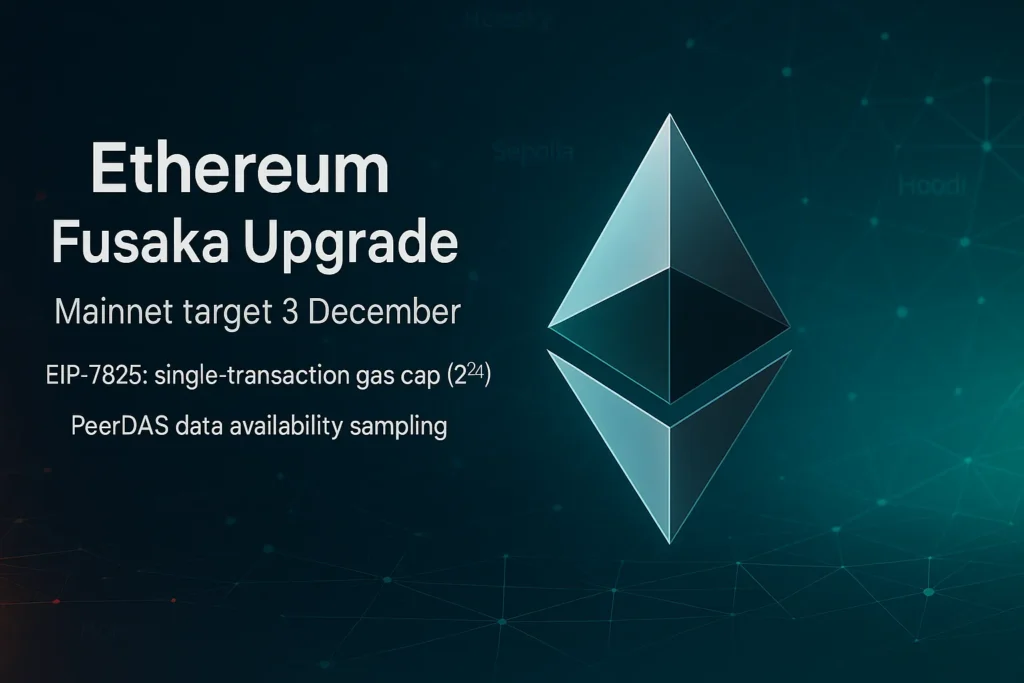
Ethereum “Fusaka” upgrade enters final testing; mainnet target set for 3 December — single-transaction gas cap and PeerDAS in focus.
22 October — Ethereum core developers and the Ethereum Foundation (EF) have confirmed that the “Fusaka” hard fork has moved into the final pre-mainnet test phase, with 3 December set as the target date for mainnet activation. The release advances both functionality and parameters: first, EIP-7825 introduces a hard cap on gas per single transaction at approximately 16.78 million; secondly, PeerDAS (peer-to-peer data-availability sampling) is being introduced to pave the way for future scaling and parallel execution. The changes are already live on the Holešky and Sepolia testnets, with a further rollout planned to a third public testnet, Hoodi.
Key technical changes
- EIP-7825: single-transaction gas cap
Under extreme conditions a single transaction could previously consume an entire block’s gas, creating a DoS risk and constraining room for parallel execution. EIP-7825 sets the per-transaction ceiling at 2²⁴ ≈ 16.78 million gas to improve block-building efficiency and predictability, preventing “mega-transactions” from monopolising block resources. The constraint is live on testnets and is slated to ship with Fusaka on mainnet. - PeerDAS: preparing for higher throughput with lower node costs
PeerDAS allows nodes to sample and verify only a subset of L2 data blobs, maintaining security while reducing hardware requirements. This lays the groundwork for higher blob throughput and lower fees. Recent EF developer guidance has asked blob producers to adapt to the new proof formats. - Phased parameter increases: the BPO (“Blob-Parameter-Only”) route
After Fusaka’s mainnet activation, developers plan a sequence of small BPO hard forks to gradually raise blob targets/limits—for example from 6/9 to 10/15, then to 14/21—following an “observe-and-roll-forward” approach to scaling.
Timeline and testing progress
EF’s October milestone and developer communications outline a clear window:
Holešky (complete) → Sepolia (complete) → Hoodi (planned for 28 October) → Mainnet (targeting 3 December). Mainnet activation is typically finalised only after the last testnet runs stably for several weeks, at which point a specific epoch/slot is announced.
Background and impact
Positioned after Dencun (2024) and ahead of Pectra (2025), Fusaka’s combination of a single-transaction cap and PeerDAS lays foundational work for parallel execution and lower L2 fees. Developers emphasise limited direct impact for everyday users; the main effects are on batching-style contracts and scripts, which should thoroughly validate transaction sizes, deployment pipelines and signing toolchains on the testnets.
Market reaction (at the time of writing)
With broader macro and crypto volatility in play, ETH trades around US$3,854, within a typical intraday range. Price action is likely to key off the cadence of testing → mainnet go-live → BPO parameter tuning, alongside realised changes in on-chain fees.